
Blog
The latest news from Geoff and Janet Benge
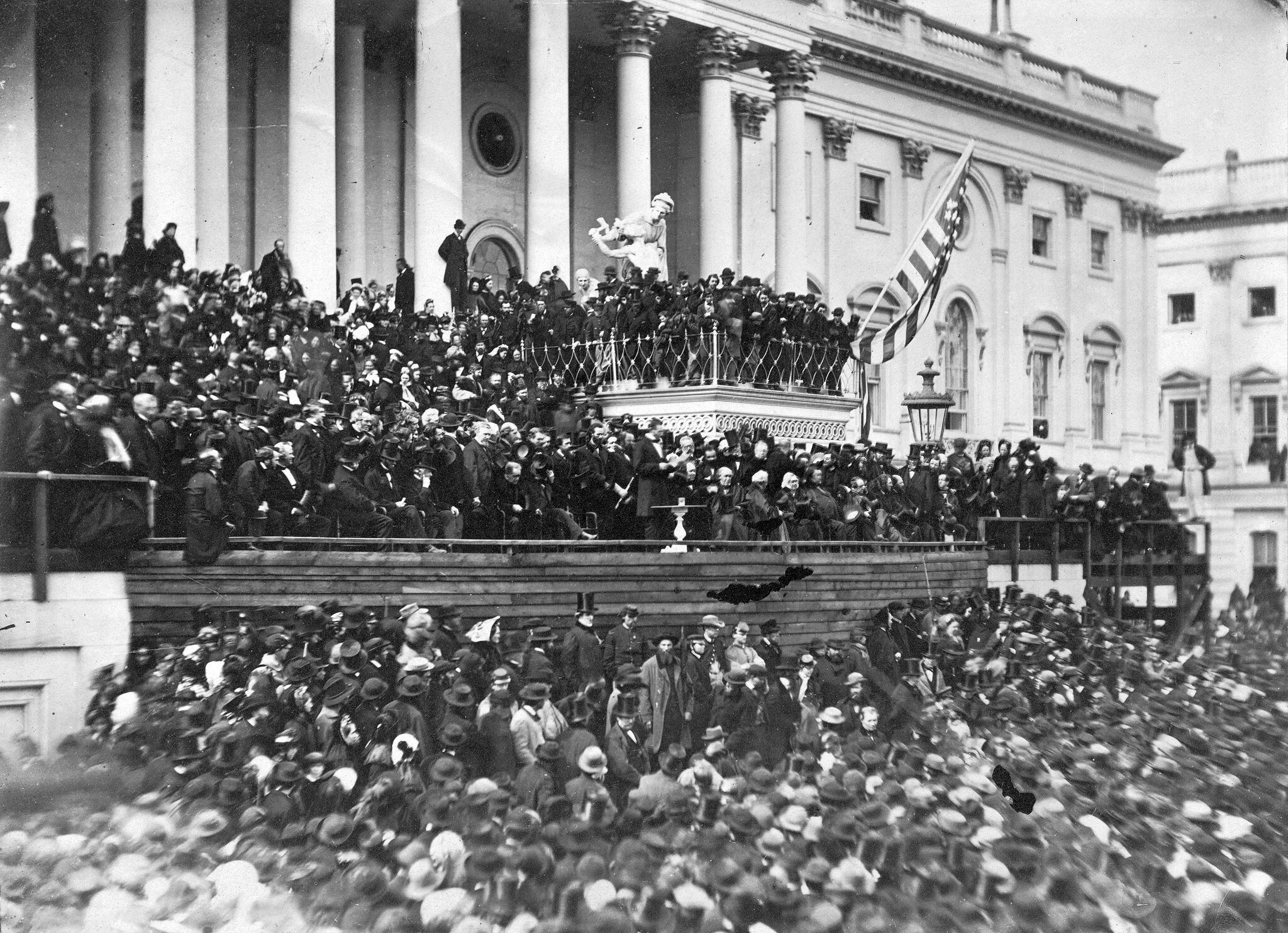
Banner Image: Abraham Lincoln delivering his second inaugural address as President of the United States, Washington, D.C. (March 4, 1865). Image by Alexander Gardner (1821–1882).
Shared Memories: What We Learned from a Summer of Reading Aloud
In the past decade, a growing body of research has confirmed what many parents and teachers have long suspected: reading aloud to children has a measurable effect on the developing brain. In The Enchanted Hour, Meghan Cox Gurdon describes research at Cincinnati Children’s Hospital Medical Center using MRI technology to observe what was happening in young children’s brains as they listened to stories. Researchers found distinctive patterns of brain activity associated with listening to stories, adding to a growing body of evidence about the benefits of reading aloud. Other research has linked reading aloud with gains in vocabulary, comprehension, attention, and the relationship between parent and child.
But there is another outcome that unfolds over time in families who read together regularly. It may not be obvious when the first book is finished, or even the fifth. Yet gradually, almost imperceptibly, something begins to form. A family develops what might be called shared vicarious memories. These are not just memories of sitting together while someone read, but memories of the stories themselves.
When a family listens to a book together, everyone enters the same world at the same moment. They feel the shock when a lion attacks David Livingstone, clamps onto his shoulder and breaks his arm. They hold their breath when Corrie ten Boom, a previously law-abiding, middle-aged woman, breaks curfew and rides her bicycle to a top-secret meeting in the dead of night. They feel William Carey’s heartbreak as he surveys the last wisps of smoke rising from the ashes of his printing press and manuscript storage room—six years of painstaking work gone. And then they marvel when the next day he begins making plans to start again.
No one sitting in the room has faced a lion, hidden Jews from the Nazis, or watched years of painstaking work go up in flames. Yet in a meaningful sense, those moments become part of the family’s shared experience. They did not live them firsthand, but they lived them together as a story. Over time, those stories become collective reference points. A line from a book can summarize a complicated situation. A character’s choice can frame a family discussion. A shared language develops, part humor, part moral shorthand, part emotional vocabulary.
To spend time with a family with a strong read-aloud habit can feel a little like arriving at a trivia night for a decade you didn’t live through, but everyone else in the room did. They recognize the references. They understand the shorthand. You sense there is history and camaraderie there, but you weren’t present for it. A good book, read aloud, can take every member of a family, young or old, to the same place, allowing them to experience the same story and carry it forward together.
Putting the Idea to the Test
This summer Geoff and I had the opportunity to watch some of this happen in real time when we invited families and reading groups to join us for our first Summer Family Read-Aloud Experience. Over six weeks, we read three of our biographies together. Alongside the reading, we hosted livestreams where we talked about the people in the books, answered questions, shared stories from our research and, when possible, brought in people with a direct connection to the story.
Of course, we hoped people would enjoy the books, but what interested us just as much was what might happen around them. Would people talk about what they were reading? Would sharing the same stories give families things to discuss that might otherwise never have arisen? Would knowing more about the people behind the books change the experience of reading them? At the end of the summer, we asked.
One family told us their reading had led to conversations about cultural differences, including how something perfectly normal in one part of the world might be surprising to someone somewhere else. Another said their family had talked about how different circumstances affect the way believers respond to what happens to them. One reader described the experience simply as an “opportunity to connect with one another through a topic we all know.” These were exactly the kinds of conversations we’d hoped might grow out of families experiencing a story together.
Something else emerged from the responses that we had not anticipated quite so clearly. Again and again, people mentioned the livestreams. Apparently, reading the story together was only part of the experience; hearing some of the stories behind the stories made a difference too. Elisa told us, “Livestreams with the authors helped us understand the people written about even more than just reading the book.”
Rosalie wrote something that particularly struck us: “You made the stories ‘real’ for us. Klaus Dieter–John is not just a story; he’s a real man in my mind now. I’ve prayed for his ministry several times already.” Somehow, through reading his story and then hearing more about him, a person she’d never met had become more than the subject of a biography. He had become a real person whose ongoing life and work mattered to her.
Stories Have a Long Afterlife
Rosalie also reminded us that none of this actually began with our Summer Family Read-Aloud Experience. Years earlier, as a church librarian, she had organized a summer reading program using our biographies. Readers kept track of how many books they finished, and one man read about forty of them during the summer. Her daughter began reading them too. More recently, a sick friend has read many of the books and discussed them with her over dinner. One book becomes forty books; a librarian introduces them to a reader; a mother reads them with a daughter; years later, a friend reads them while she is sick and talks about them over dinner. Stories have a way of traveling.
Perhaps that is part of what makes reading aloud so powerful. The book ends, but the experience doesn’t necessarily end with it. Years later, when the children are grown and some incredibly difficult situation looms, someone might say, “Remember what William Carey did the day after his printing room burned to the ground along with his translated manuscripts?” Everyone in the room knows exactly what that means because, in a small but meaningful way, they were all there together.
In an age of fragmented attention and individualized screens, the simple act of listening to a book together is quietly countercultural. It gives us something increasingly rare: a story we experienced together. This summer reminded Geoff and me that perhaps the real value of a family read aloud isn’t simply getting everyone through the same book. It is the memories, conversations, connections and shared language that grow around it—and what happens between the people who read it.
—Janet Benge
A Free Family Read-Aloud Experience with Janet and Geoff Benge
This summer, for the first time, we (Janet and Geoff) are inviting families to share six weeks of summer reading with us.
For more than 25 years, families around the world have read our Heroes books aloud together. Countless parents have shared with us that this reading approach has strengthened family relationships, sparked meaningful conversations, inspired their children, and created memories that will last a lifetime.
During the free Family Read-Aloud Experience, families will read one book aloud at home over two weeks and then join Janet and Geoff for a livestream conversation about the story, the history behind it, and interviews with people carrying on the legacy today. We will also share behind-the-scenes insights about writing the book and offer simple cross-generational questions to spark thoughtful family conversations and reflection.
This will be a powerful experience because:
• Generations are listening to the same story together.
• Participants are talking about what stood out to them during the reading.
• Participants are connecting the story to everyday life.
• Participants are interacting with the authors.
Over six weeks—an average of about one chapter a day—participating families will read three books Janet and Geoff have chosen for the Read-Aloud Experience:
Lillian Trasher: The Greatest Wonder in Egypt (1887–1961)
Louis Zamperini: Redemption (1917–2014)
Klaus-Dieter John: Hope in the Land of the Incas (1960–)
The Family Read-Aloud Experience is a free event and runs from Monday, July 13 through Sunday, August 23, 2026.
Livestream sessions will be held each Friday at 1:00 PM EST: July 17, July 24, July 31, August 7, August 14, and August 21.
You will be able to post questions for Janet and Geoff in the chat during the livestream and will also be provided an email address where you can send questions ahead of time. Those who register for the Read-Aloud Experience will receive an email containing a direct link to the livestream.
For those who cannot attend live, the livestream will be recorded and made available for all to view the following day (Saturday) on our YouTube channel.
How do you join this inspirational family event? Email us at:
and let us know:
• How many people will be participating in your particular read-aloud group.
• The email address where you would like the livestream link sent.
If you need copies of the books we’ll be reading, you can purchase printed, audio, or eBook versions directly from YWAM Publishing using our affiliate by clicking here.
The books are also available for sale on Amazon.
Once you email us, you will hear from us in early July with more information and a link to an introductory video that will appear on our Benge Books YouTube channel.
In the meantime, for more information you can also email Janet and Geoff at inquiry@bengebooks.com.
We look forward to spending time with you and your family during July and August.
—Janet & Geoff Benge
The BIG Reveal—Introduction to Journal Writing Course
A year ago this month, at the FPEA Convention, we talked with Tricia Goyer who shared she and a friend Angela Love were starting an online platform to host courses for homeschooled high schoolers. Tricia asked if we had a course we would like to have on their new platform. Of course, my mind immediately jumped to something near and dear to my heart—journaling.
Even though I’ve been a writer for forty plus years, each New Year I never got past January 10 in my attempt to develop a journaling practice. Then three years ago I sort of backed into journaling through a side door and fell in love with it. The change came from realizing I had a rigid idea of what a journal was and my mind would rebel at writing down my thoughts and emotions on a daily basis. So, I found other ways to journal. Now it is something I look forward to doing every day, which is still hard for me to believe.
Anyway, when Tricia asked us about any course ideas we had, my mind leapt. And so, it was decided we should put together a course on journaling.
I had no idea it would take eleven months from the time we started developing the course, but it did. There was a learning curve as we put together and videoed each segment, not to mention the worksheets that go with each lesson. And of course, being us, the course covers a brief history of each journal form explored.
I like to think of the course like a sampler, a place where students get to try out nine different forms of journaling and then spend three weeks experimenting and deciding which journaling styles suit them in the hope they develop an ongoing journaling practice.
I’ve found that journaling has improved my creativity and mental health, given me additional joy and clarity, and I hope the course contents will do the same for many high school students around the world.
To learn more, click here.
—Janet Benge
Get Updates
Want to be the first to know when new books are available? Sign up for the Benge Books newsletter!